Green Land: A Font That Brings Nature's Calm to Your Designs
Understanding the Visual Heart of Green Land
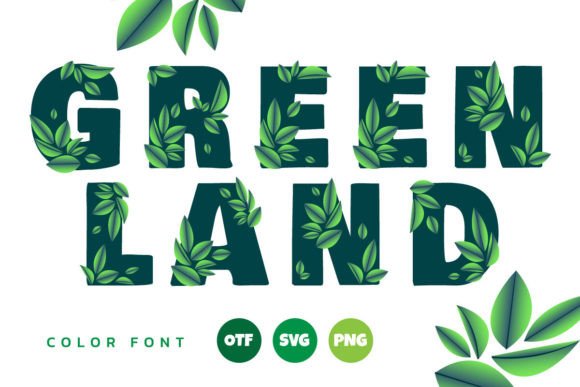
When you first encounter Green Land, it’s less like seeing a font and more like stepping into a shaded grove. This isn't just another typeface; it's a carefully crafted color font, meaning the deep, verdant green is baked directly into the letterforms. The visual characteristics are immediately striking. The strokes have a certain weight and fluidity, reminiscent of thick, healthy leaves or perhaps the smooth bark of a young tree. It possesses a gentle roundness that softens its presence, making it feel approachable rather than rigid. The overall personality is one of tranquility, growth, and organic vitality. It doesn’t shout for attention; it invites the viewer in, much like a well-maintained garden path.
This style sits in a unique space. It’s not a traditional serif font with its formal, bookish strokes, nor is it a stark, geometric sans serif font. You might call it a display font with a strong character, but its legibility at certain sizes is surprisingly good for its decorative nature. The appeal is universal for projects that want to communicate authenticity, health, or a connection to the earth. Think of a local organic farm’s logo, a wellness app’s interface, or the chapter headings in a book about sustainable living. The font itself carries a message before a single word is read.
Where Green Land Truly Comes Alive
Knowing where to deploy a creative font like Green Land is key to its success. Its strengths shine in specific contexts. For brand identity work, it’s a powerhouse for businesses rooted in nature, wellness, food, and sustainability. A juice bar, a yoga studio, or an eco-friendly product line can build a cohesive and instantly recognizable logo design around this typeface. The color and form work together to create an immediate emotional connection with the target audience.
In marketing and social media graphics, Green Land cuts through the noise of generic, black-and-white text. It’s perfect for headlines on posters promoting a farmers' market, Instagram stories for a botanical garden, or email headers for a travel blog focused on national parks. Its use in editorial design is equally compelling. Imagine it as a drop cap in a magazine article about reforestation or as a pull quote in a report on climate action. It adds a moment of visual rest and thematic reinforcement.
For packaging design, especially for natural cosmetics, herbal teas, or organic snacks, the font contributes to a perception of purity and care. It tells a story on the shelf. In the digital realm, while it’s not suited for body text in a web design, it excels as a hero banner font, a button label, or a decorative element in a UI that wants to feel fresh and modern. Even for personal projects, like designing a family recipe book or crafting invitations for a garden party, Green Land adds a layer of professional polish and personality that generic fonts can’t match.
The Subtle Power of a Thematic Typeface
A font does more than display words; it shapes perception. Choosing Green Land influences your project’s visual hierarchy and brand perception profoundly. Its distinct color and form naturally draw the eye, making it an excellent tool for creating focal points. A headline set in Green Land will anchor a page, guiding the viewer’s journey through the content. This establishes a clear visual hierarchy, where the most important message is delivered with the most impactful voice.
This choice directly impacts brand perception. Using a premium font like this signals that you value quality and attention to detail. It tells your audience you’ve thought carefully about every element, which builds trust and professionalism. Consistency is another benefit. When you use Green Land across your website, social media, and printed materials, you create a unified visual language. This consistency is the bedrock of strong brand recognition. Your audience will begin to associate that specific shade of green and those organic letterforms with your message, making you more memorable in a crowded marketplace.
Ultimately, it drives engagement. A design that feels authentic and emotionally resonant is more likely to be read, shared, and acted upon. The tranquility of the font can make complex information feel more accessible, and its vitality can energize a call to action. It’s a tool for connection.
Making Green Land Work for Your Project
So, how do you practically integrate this into your workflow? Start by evaluating fit. Does your project’s core message align with themes of nature, growth, or freshness? If yes, it’s a strong candidate. Next, test it rigorously. View it at the sizes you’ll actually use. Check its readability on different screens and in print proofs. A font that looks stunning in a large headline might lose clarity when shrunk for a caption.
Consider font pairing. Green Land has a strong personality, so it pairs best with something neutral and clean. A simple, geometric sans serif font for body text is often a perfect companion. This creates contrast and ensures the overall design doesn’t become overwhelming. Look at the full package. Does the commercial font license cover all your intended uses—web, print, merchandise? Are there alternate characters or ligatures that can add more variety? Review the included styles; sometimes a weight or a stylistic set can unlock new possibilities.
Think about readability as a hierarchy. Use Green Land for moments of impact: a single powerful word, a short phrase, a title. Let it be the accent, not the entire conversation. For longer passages of text, choose a more conventional typeface. This approach ensures your design is both beautiful and functional. By treating Green Land as a strategic design asset rather than just a decorative element, you can harness its full potential to create work that feels genuinely alive and connected to the natural world.